
Choosing a stage LED screen is rarely just about picking a size and getting a quote. The screen becomes part of the show itself. It carries branding, magnifies performers, supports sponsors, guides audience attention, and often determines how connected the back rows feel to the stage.
That is why the best choice starts with the event, not the hardware alone. A screen that looks perfect at an indoor general session may struggle at a daytime festival. A strong buying or rental decision comes from balancing image quality, sightlines, content, safety, setup logistics, and support. When those pieces work together, a stage LED screen does more than fill space. It gives the audience a clear, vivid reason to stay engaged.
Stage LED screen goals for live events
Before comparing specifications, define what the screen must accomplish. From concerts, corporate events, theater, sports presentations, festivals, civic events, and brand activations. The right setup for one may be inefficient for another.
Some events need one large center wall that acts as the visual anchor. Others need side screens, scenic columns, DJ booths, backdrop walls, delay screens, or a mix of modular pieces with unusual dimensions. Content matters just as much. Fast-moving IMAG feeds, sponsor loops, PowerPoint graphics, cinematic motion backgrounds, and live scoring all place different demands on the display system.
A useful starting point is to define the screen’s job in plain language.
- audience magnification
- scenic background
- sponsor visibility
- presentation support
- wayfinding or information
- camera-friendly broadcast image
That short exercise quickly sharpens the rest of the decision.
Stage LED screen specifications that matter most
Specs can be confusing because a sheet full of numbers does not automatically tell you how the screen will perform at your event. A few technical factors drive most real-world results.
Pixel pitch and viewing distance for stage LED screens
Pixel pitch refers to the distance between pixels, measured in millimeters. Smaller pitch means tighter pixel spacing and a sharper image at closer viewing distances. Larger pitch can still look excellent when the audience is farther away.
Indoor stages, especially corporate sets and theater environments, often benefit from finer pixel pitch because guests may sit close to the screen. Outdoor concert and festival stages usually allow for a wider pitch because the primary audience is farther back and ambient light is much stronger.
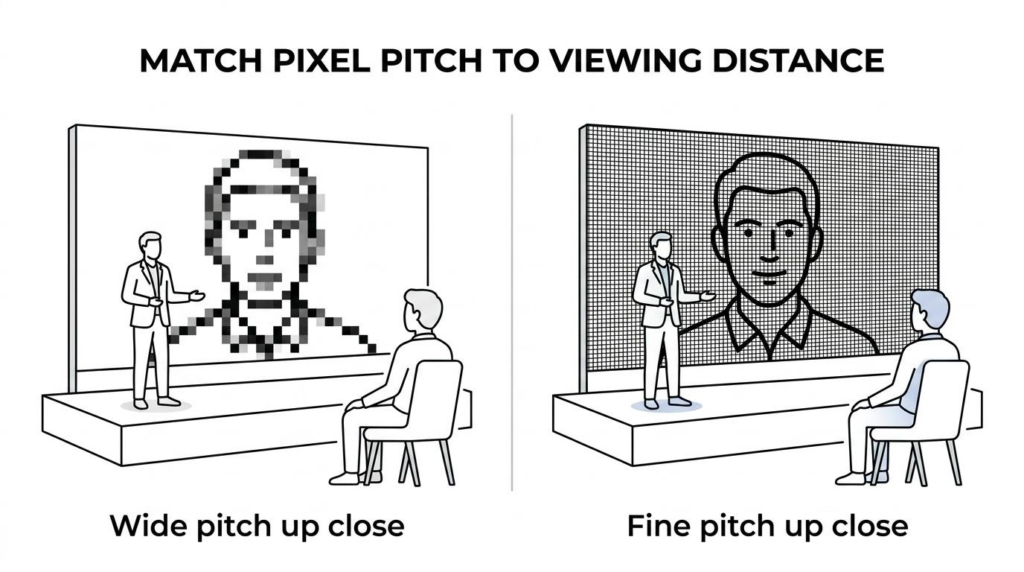
Side-by-side stage LED examples showing a fine-pitch indoor screen for close seating and a wider-pitch outdoor screen for a distant crowd.
A simple rule helps: the closer the audience, the finer the pitch should be. Paying for extremely fine pitch on a large outdoor stage with long viewing distances may add cost without a visible gain.
Brightness and contrast for indoor and outdoor events
Brightness is essential, especially outdoors. A stage LED screen must compete with daylight, shifting cloud cover, stage lighting, and reflected surfaces. Indoor events usually need less brightness, yet still need enough output to stay vivid under production lighting.
Contrast and black level matter too. A screen with strong brightness but weak contrast can look washed out. This is especially noticeable with darker scenic content, video packages, and premium brand visuals.
Refresh rate and camera performance for live production
Refresh rate becomes very important when cameras are involved. A stage screen may look fine to the eye but produce flicker, scan lines, or moiré patterns on camera if the display and camera system are not well matched.
Concerts, streamed events, awards shows, and corporate productions often need LED systems that cooperate cleanly with camera shutters and switching workflows. If the event includes recording, live streaming, or IMAG, this should be discussed early with the screen provider and video team.
Processing, scaling, and content mapping for LED walls
The screen is only part of the image chain. Processing determines how content is scaled, mapped, switched, and displayed. Odd screen dimensions, multiple outputs, live camera feeds, and mixed media all rely on capable processing.
Poor processing decisions can leave a great screen looking mediocre. Sharp image reproduction, proper aspect ratios, smooth motion, and consistent color all depend on the complete system.
Indoor vs outdoor stage LED screen decisions
The indoor or outdoor question affects nearly every other choice. It influences brightness, cabinet style, weather resistance, power planning, structural requirements, and setup time.
Outdoor stage LED screens must handle sun, wind, moisture, temperature shifts, and variable terrain. They also need enough brightness to remain readable in harsh daytime conditions. Indoor systems can focus more heavily on fine detail, scenic integration, and close-range image quality.
The table below shows how priorities often shift by event type.
| Event Type | Typical Screen Priorities | Common LED Direction |
|---|---|---|
| Corporate general session | Fine detail, presentation clarity, camera-friendly image | Fine-pitch indoor modular wall |
| Concert or music festival | Brightness, large scale, IMAG support, rugged setup | Outdoor modular walls plus side screens |
| Theater or gala | Scenic integration, black levels, close audience viewing | Indoor LED wall with tighter pitch |
| Sports watch party or fan zone | Visibility at distance, weather readiness, fast setup | Outdoor high-brightness screen |
| Brand activation | Custom sizing, sponsor impact, flexible placement | Modular wall or mobile screen depending on footprint |
| Civic event or public gathering | Reliability, readability, quick deployment | Outdoor modular or mobile LED solution |
There is also a practical middle ground. Some events use a modular stage wall as the hero display and add mobile LED trailer screens as support screens for overflow areas, side audience sections, or sponsor zones. That kind of mixed deployment can improve sightlines without overbuilding the main stage.
Stage LED screen size, shape, and sightline planning
A screen can be technically excellent and still disappoint if the audience cannot see it comfortably. Size should be based on venue depth, audience width, seating rake, stage trim height, and scenic obstructions.
Bigger is not always better. An oversized wall can overpower presenters, block lighting positions, create camera exposure challenges, or force awkward set proportions. A wall that is too small has the opposite problem: the event pays for LED and still loses audience engagement in the rear or side sections.
When planning dimensions, consider these practical issues:
- center wall versus side screens
- trim height and stage roof clearance
- speaker hangs and lighting towers
- audience width and viewing angles
- scenic masking and branding areas
Shape matters too. Standard 16:9 layouts are easy for presentations and video playback. Wide panoramic walls create a premium visual field for concerts and scenic content. Tall portrait columns work well for sponsor loops, artistic visuals, or stage wings. Modular LED systems are valuable because they can be configured around the creative design instead of forcing the event into a fixed format.
Content design and stage LED screen performance
One of the most common mistakes is choosing a screen before reviewing the actual content plan. Content and screen choice should be developed together.
Text-heavy keynote slides need clarity and safe margins. Live camera shots need natural skin tones and smooth motion. Fast-moving animated backgrounds need strong processing and disciplined brightness control so they do not overpower the speakers or performers. Sponsor content often needs consistent visibility without looking intrusive.
This is where many events gain value from early consultation. A provider that asks about content sources, playback systems, camera needs, ambient light, and staging intent is usually helping protect the final image, not just selling square footage.
A few planning questions can quickly reveal whether the screen package fits the show.
- What content will run most often: IMAG, slides, branding, motion graphics, or a mix
- How close is the nearest audience section: This strongly affects pixel pitch
- Will the event be recorded or streamed: Refresh rate and camera compatibility matter more
- What time of day will the screen be used: Full daylight and evening shows need different brightness strategies
- Does the set design require custom shapes: Modular flexibility may be more valuable than a standard wall
Rigging, power, and safety for stage LED screen installation
A stage LED screen is not just a display. It is a structural, electrical, and operational element of the production. That means installation planning deserves the same level of attention as the screen itself.
Some walls are ground-supported. Others are flown. Either approach must fit the venue, stage roof capacity, engineering limits, and show schedule. Load calculations, ballast plans, cable runs, power distribution, and technician access all affect success on site.
As Selskabskælderen’s guide to creating a light and sound plan points out, agreeing cues, equipment placement, and responsibilities early helps prevent on-site friction and keeps the production timeline realistic.
Outdoor events add more variables. Wind action plans, weather procedures, and backup options should be discussed early. The same goes for access. A great screen package becomes less great if the loading dock, lift access, or setup window cannot support it.
This is an area where operational experience really shows. A seasoned LED partner usually sees issues before they become expensive, whether that means recommending a different cabinet type, modifying the wall dimensions, adjusting support structure, or adding backup components to protect show continuity.
Reliability and support for a stage LED screen rental
LED quality matters, yet service quality often determines whether the event feels calm or chaotic. Live events run on deadlines, and there is rarely room for trial and error during load-in or showtime.
Ask what level of support is included. Some projects need delivery and installation only. Others need on-site technicians, content checks, show operation, overnight security coordination, or standby troubleshooting during long show days. Backup equipment availability is also worth asking about, especially for high-visibility events.
A reliable support plan often includes:
- Pre-show review: venue details, content sources, power, rigging, schedule
- On-site setup: installation, testing, calibration, and signal verification
- Show support: operation, monitoring, and real-time issue response
- Redundancy planning: spare parts, backup signal paths, or replacement units when needed
For event organizers and production teams, this service layer can be just as valuable as the screen itself. It protects the schedule, supports creative goals, and reduces risk when audiences, sponsors, or broadcast elements are involved.
Stage LED screen budget factors and value decisions
Price matters, though low price alone rarely produces the best event outcome. Stage LED screen costs are shaped by more than wall size. Pixel pitch, brightness level, cabinet type, processing, structural support, labor, travel, schedule length, and support coverage all affect the final number.
It helps to think in terms of value rather than square footage alone. A slightly more capable screen package may save money elsewhere by reducing scenic build, improving sponsor visibility, or eliminating the need for additional projection or printed graphics. In many events, the LED wall becomes the most flexible visual element on stage.
This is also where rental can be far more sensible than ownership for many organizations. Event-by-event rental gives access to the right screen format, current technology, proper installation, and technical support without carrying maintenance, storage, transport, or obsolescence costs.
When comparing quotes, ask whether they include the full scope or only the base display. A useful proposal should make clear what is and is not included.
Questions to ask before booking a stage LED screen
A good decision usually comes down to asking better questions early. That keeps technical discussions tied to event goals instead of turning into a race between spec sheets.
Start by asking how the provider would configure the screen for your specific audience, venue, and content mix. If the answer is thoughtful and practical, that is a strong sign. If the answer jumps straight to a generic size recommendation, there may be gaps in the planning process.
It also helps to ask about deployment experience across different event types, support availability during the show, and contingency planning if weather, logistics, or content needs change. For many organizers, the strongest partner is not just the one with impressive equipment, but the one that can scale the right system, install it cleanly, and keep it performing under pressure.
A well-chosen stage LED screen gives the event clarity, energy, and reach. It helps every seat feel closer to the action, every sponsor message land more cleanly, and every production cue hit with confidence. That is what makes the selection process worth doing carefully from the start.